TITLE: Vienna Hunting Carpet
ORIGIN: Isfahan, Iran
EOCH. PERIOD: Safavid Empire, Iran
DATE: Second half of the 16th century
MATERIAL: Silk, Silver and Silver-Gilt Thread
TECHNIQUE: Persian knot, 1,274,000 knots per sq. m (822 knots per sq.in)
- 108 knots per 10 cm. across
- 118 knots per 10 cm. lengthwise
DIMENSIONS : 695 x 323 cm (274 x 127 in.)
- Warp of yellow silk
- Double weft of yellow silk
- Silk Pile, enriched in parts with silver and silver-gilt thread on white silk
LOCATION: The MAK – Museum of Applied Arts, Vienna, Austria
NOTE:
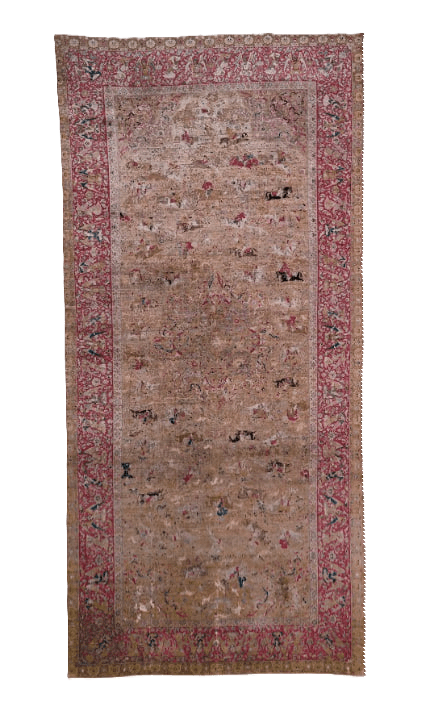
This carpet exudes unparalleled elegance, leading many to long presume it to be a variety of silk velvet. Undoubtedly, it stands as one of the masterpieces in Iranian carpet weaving art. The design of the carpet, stemming from the court of Shah Tahmasab I, appears to have been entrusted to court painters who served the discerning ruler with an appreciation for art. There is a belief among some that this carpet was crafted by Sultan Mohammad, a pupil of the renowned Iranian painter Behzad. This attribution is rooted in the historical context of Sultan Mohammad’s service under Shah Tahmasb during that period.
At the carpet’s center, a star pattern is surrounded by a notched motif, repeated throughout the carpet’s square. Within the carpet’s field, a captivating blend of real and mythical creatures, such as dragons and the Simorgh (the Phoenix), can be discerned amidst the artistic twists of flowers and leaves. In the pink background, riders and footmen are depicted, following a procession of 58 horses and 157 other animals, including lions, foxes, zebras, bears, jackals, and boars.
The surrounding borders showcase “Peris” (angel-like creatures) against a backdrop of beautiful ivy. The art of the East takes center stage with its unique allegorical representation, where hunters are intricately woven on one side and their prey on the other. The hunters are adorned in authentic Iranian attire prevalent during the Safavid era, equipped with bows, lances, sabre, and clubs.
On the carpet’s edges, intricate patterns featuring an abundance of flowers and nightingales captivate the eye, with depictions of people sitting and kneeling among them. What makes this pattern particularly intriguing is the visual narrative it conveys – the last person in the sequence is seen presenting a gift to the first person, adding a captivating touch of symbolism and storytelling to the overall design.
 Ghalin History
Leave a comment