TITLE: Vase Carpet
ORIGIN: Center of Iran or South-East of Iran, Probably Kerman
EOCH. PERIOD: Safavid Empire, Iran
DATE: First half of the 17th Century
MATERIAL: Wool, Probably Silk
TECHNIQUE: knotted pile, 870,400 knots per sq. m (544 knots per sq.in)
- 64 knots per 10 cm. across
- 136 knots per 10 cm. lengthwise
DIMENSIONS : 519 x 330 cm (204 x 130 in.)
- Warp of Cotton
- Weft of Cotton and possible Silk
- Wool Pile
LOCATION: Victoria and Albert Museum (V&A), London, United Kingdom
NOTE:
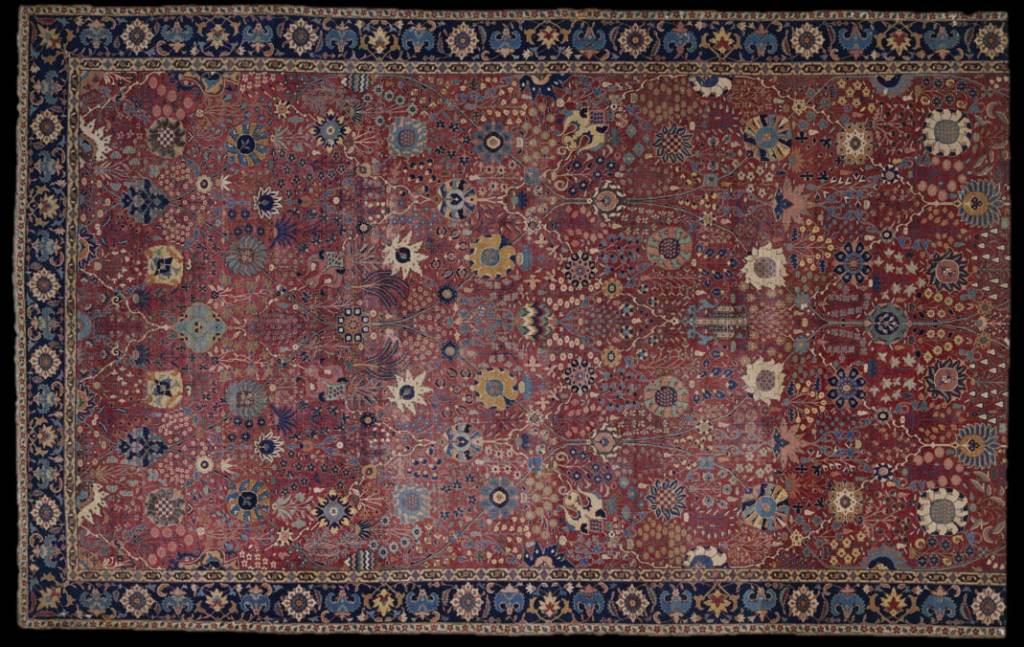
This carpet fragment belongs to a longer piece categorized as a flower-patterned carpet. Its intricate flower and leaf design is set against a reddish-pink background, showcasing a level of complexity that distinguishes it as an exceptional example of Persian carpet design. The intricate nature of the design suggests that it may not be a common motif but rather a custom creation, reinforcing the hypothesis of its unique and specialized origin.
The design incorporates a vase interwoven with branches and leaves, symbolizing the presence of flowers and substantial stems within the vase. the half-vase motif in the lower section adds a nuanced and captivating element to the overall composition. The complexity of this design may not be immediately apparent to those unfamiliar with Persian carpets, adding to its status as one of the more intricate motifs in this artistic tradition.
The narrow border of the carpet features motifs of small flowers and leaves, contributing to its overall aesthetic appeal. Regarding color, the carpet exhibits a three-tiered palette, with distinguishable blue-black, thorny white, and leafy blue hues. Some experts suggest the weaving origin is Jowshaqan-e Qali in central Iran, while others lean towards Kerman in the southeast due to the carpet’s utilization of the “Vase Technique,” a design more commonly associated with Kerman carpets.
 Ghalin History
Leave a comment