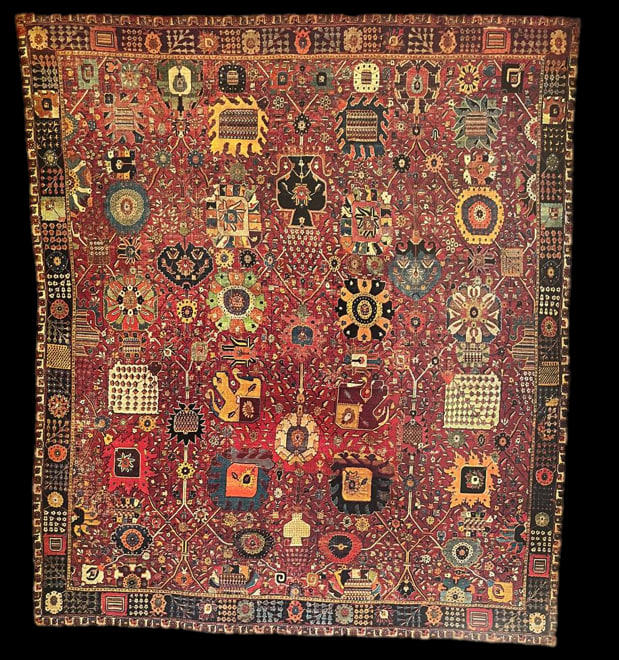
TITLE: Vase Carpet
ORIGIN: South-East of Iran, Kerman or Center of Iran, Jowshaqan-e Qali, Isfahan Province
EOCH. PERIOD: Safavid Empire, Iran
DATE: End of the 16th Century
MATERIAL: Wool, Cotton
TECHNIQUE: Persian knot, 275,000 knots per sq. m (177 knots per sq.in)
- 50 knots per 10 cm. across
- 55 knots per 10 cm. lengthwise
DIMENSIONS : 409 x 353 cm (161 x 139 in.)
- Warp of Unbleached Cotton
- Weft of Unbleached Cotton
- Wool Pile
LOCATION: Collection of the Carpet Museum of Iran, Tehran
NOTE:
This carpet takes its name from the vase depicted in the lower half, featuring stunning geometric flower designs that appear to flourish from the vase and extend across the entire carpet. A smaller vase motif is also visible in the upper half. The overall design incorporates an abundance of small flowers throughout the scene and includes four rows of diverse geometric patterns featuring various types of flowers.
The carpet’s border, relatively small in size, showcases a variety of geometric patterns and flowers. The origin of this carpet’s weaving is a subject of discussion. Some assert that it was crafted in Jowshaqan-e Qali, situated in the center of Iran, where numerous carpet weaving workshops thrived during the time of Shah Abbās the Great. However, others argue that due to its use in the court of Shah Abbās the Great, it may have been woven in Isfahan or Kerman, located in the southeast of Iran.
The carpet possesses an almost square shape, reinforcing the theory that it is likely a custom-woven piece with these distinct dimensions.
 Ghalin History
Leave a comment