
TITLE: Pile Carpet
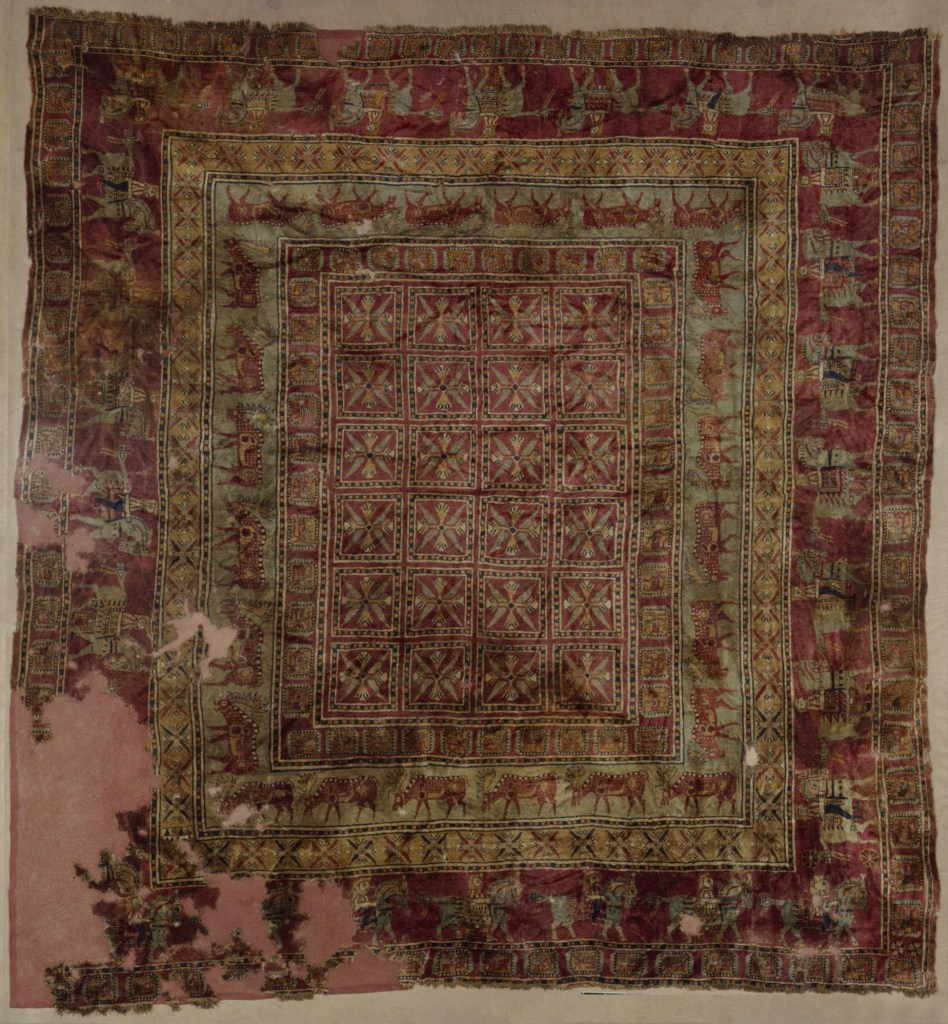
ORIGIN: Persia Empire
EOCH. PERIOD: Early Iron Age
DATE: Pazyryk Culture. 5th – 4th century BC
PLACE OF FINDING: Altai Territory, Pazyryk Boundary, the Valley of the River Bolshoy Ulagan
ARCHAEOLOGICAL SITE: Pazyryk Barrow No. 5 (excavations by S.I. Rudenko, 1949)
MATERIAL: Wool
TECHNIQUE: Turkish knot, c.3600,000 knots per sq. m. (232 knots per sq.in.)
DIMENSIONS : 183×200 cm
LOCATION: Hermitage Museum in St. Petersburg, Russia
NOTE:
The Pazyryk carpet is considered the world’s oldest known carpet. When examining this artifact, one cannot help but marvel at the natural ice that preserved it in the Altai Mountains of Central Asia. Although discovered amidst Scythian artifacts, experts posit that it originated in Iran, drawing this conclusion from the striking resemblance of its design to the stone carvings and sculptures found in Persepolis. Along the inner border of the carpet, a line of elks is depicted, while the outer border showcases twenty-eight horsemen, seemingly transporting the throne of King Xerxes to Persepolis. In the carpet’s field, square shapes adorned with large rings captivate the observer’s attention.
 Ghalin History
Leave a comment