TITLE: The Chelsea Carpet
ORIGIN: North-west Iran, Tabriz, East Azerbaijan or Ardabil, or Qazvin
EOCH. PERIOD: Safavid Empire, Iran
DATE: First half of the 16th Century (900 in the Persian Hijri Calendar)
MATERIAL: Wool, Cotton, Silk
TECHNIQUE: Persian knot, 738,700 knots per sq. m (477 knots per sq.in)
- 89 knots per 10 cm. across
- 83 knots per 10 cm. lengthwise
DIMENSIONS : 540 x 316 cm (213 x 124 in.)
- Warp of green silk
- Double weft of white silk
- Wool Pile
LOCATION: Victoria and Albert Museum (V&A), London, United Kingdom
NOTE:
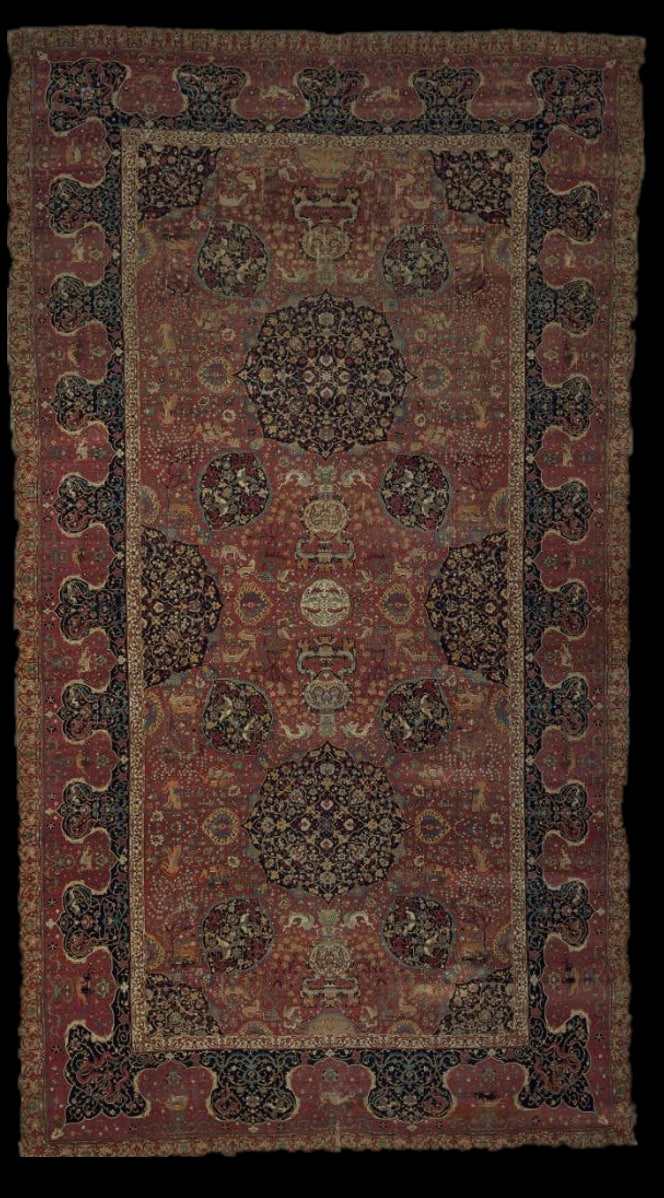
Regarded by some as the most exquisite carpet globally, debates surround the origin and crafting date of this masterpiece. Due to its pattern’s striking resemblance to book arts from the Safavid period in Iran, scholars assume it belongs to that era. Additionally, the similarity with the Ardabil carpet suggests it originated in the same region, the northwest of Iran. Despite its expansive size, the carpet boasts an intricately complex design.
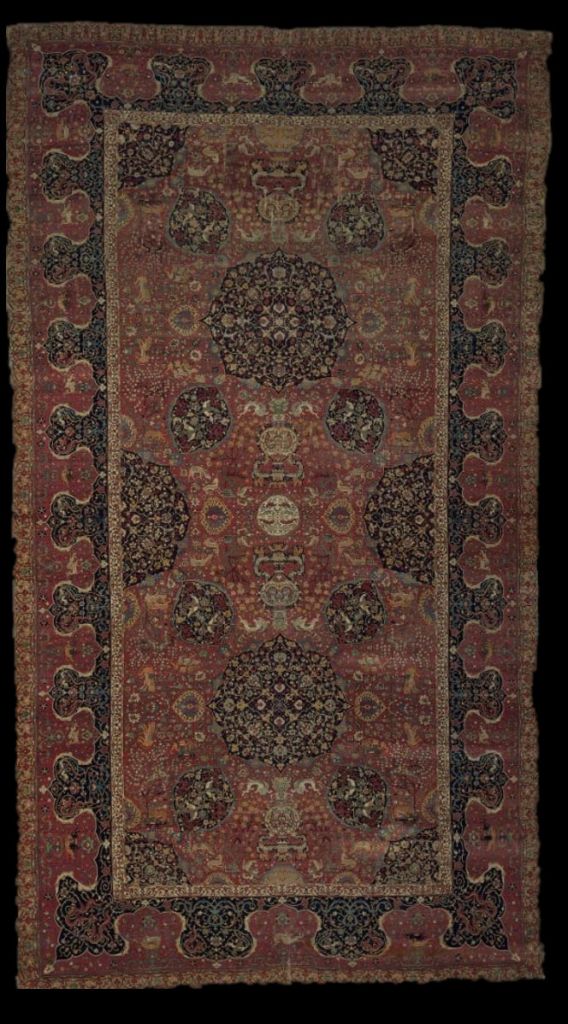
The overall layout features two lobed black “Toranjs” along the central axis, each adorned with four diagonal radiating oval pendants, all set against a deep red main field. Quarter-Toranj repetitions occupy the four corners, while two half-Toranj flank either side. Each Toranj showcases a refined radial design of yellow strapwork and large flowers, while oval pendants feature fluttering birds and Chinese style cloudbands.
Beneath this Toranj superstructure, the red main field unveils a rich and diverse garden landscape teeming with trees and wildlife. Amid blossoming trees, various birds and animals move about. Notably, the bergamot in the center resembles a pond with swimming fish. White-blossomed trees, ripe pomegranates, leafy spiraling stems, and large lotus flowers add to the vibrant garden. Animals and birds, including resting pairs of spotted goats, lions, and treetop birds, populate the greenery. Predominantly, hunting scenes unfold leopards attacking horned goats, hawks seizing long-legged water birds, and lions ambushing stags. Ornate Chinese-style vases along the central axis, formed of dragons, lions, and peacocks, add another layer of complexity.
Furthermore, four large vases, guarded by dragons, contribute to the carpet’s intricate design. The carpet’s edge showcases opposing and beautifully drawn spiral patterns featuring dragons and simorgh. Beyond the main field, the main border presents a reciprocal pattern of interlocking arcades in red versus black (or extremely dark blue indigo). On a slightly condensed scale, this border also features hunting pairs, such as a snow leopard attacking a horned goat and a lion subduing a bull. Supernatural creatures confront each other in the dark blue arcading: a Chinese-style dragon faces a long-tailed phoenix.
Throughout the main and two minor borders, overlaid designs of leafy plant scrolls and Chinese cloudband motifs enhance the intricate details. The carpet earned its name from its purchase from a Chelsea-based merchant, adding to its storied history.
 Ghalin History
Leave a comment