TITLE: The Ardabil Carpet
ORIGIN: North-west Iran, Tabriz, East Azerbaijan Province, or Center of Iran, Kashan, Isfahan Province
EOCH. PERIOD: Safavid Empire, Iran
DATE: 1539 (918 in the Persian Hijri Calendar)
MATERIAL: Wool, Cotton, Silk
TECHNIQUE: Persian knot, 517, 500 knots per sq. m (334 knots per sq.in)
- 69 knots per 10 cm. across
- 75 knots per 10 cm. lengthwise
DIMENSIONS : 540 x 316 cm (213 x 124 in.)
- Warp of yellow silk
- Double weft of yellow silk
- Wool Pile
LOCATION: Victoria and Albert Museum (V&A), London, United Kingdom
NOTE:
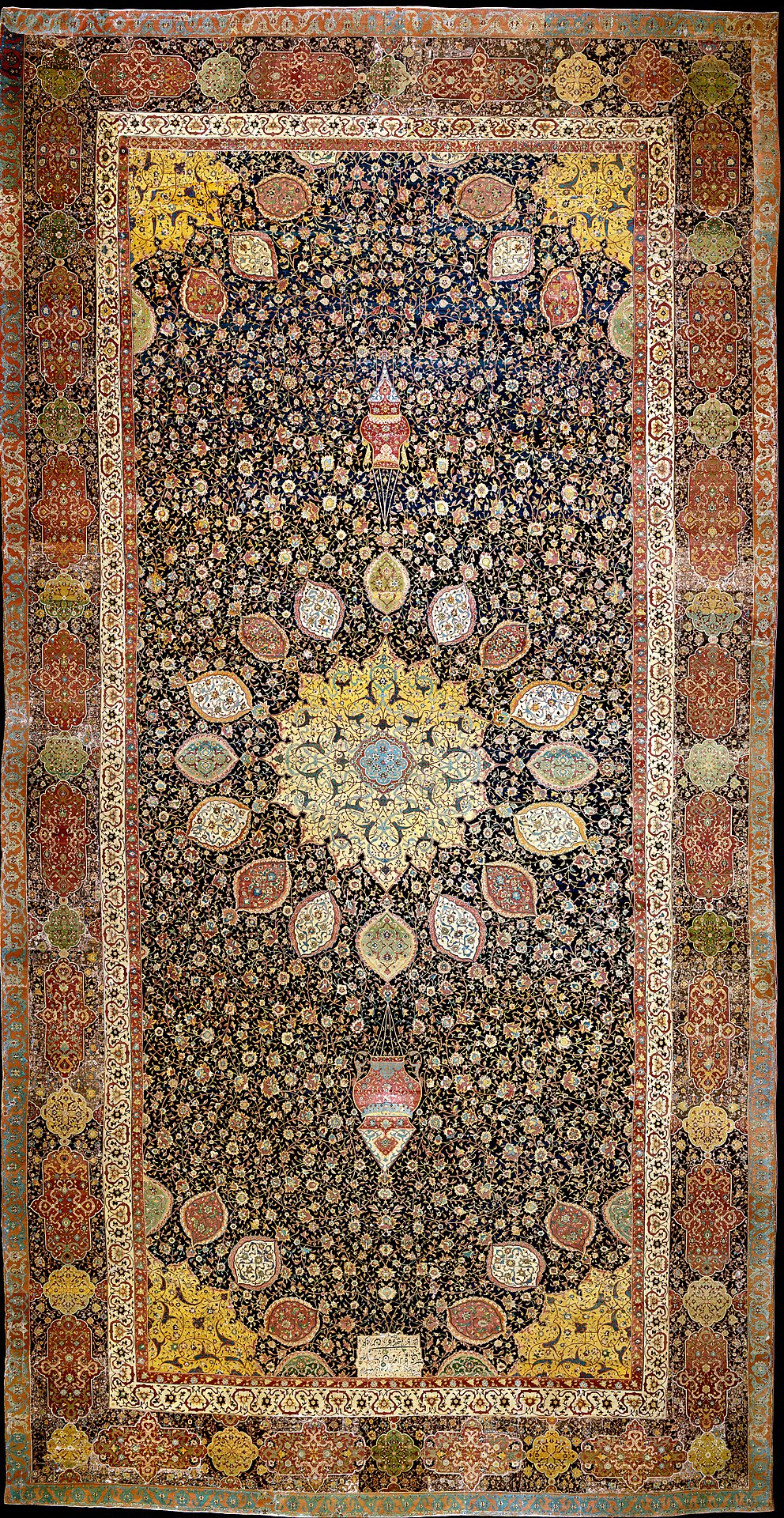
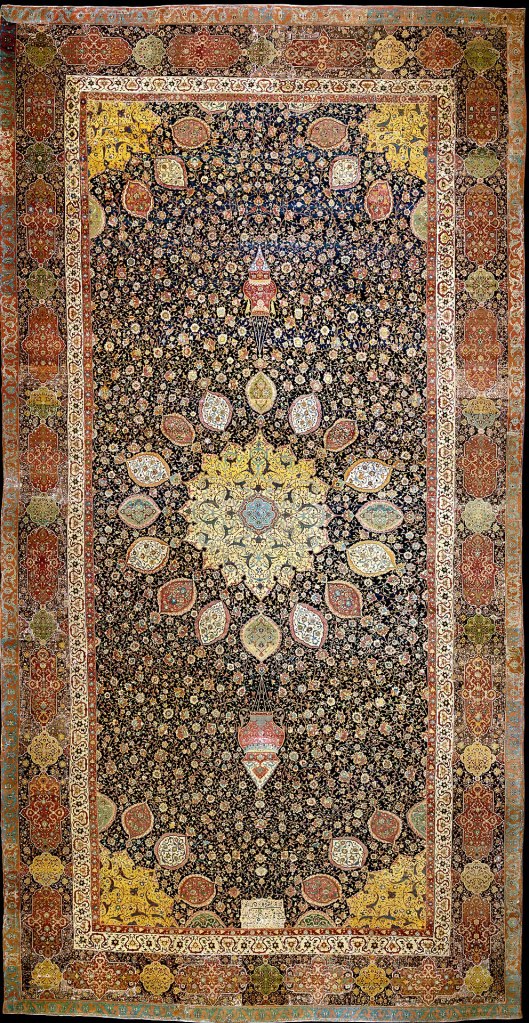
The Ardabil carpet comprises a pair of world-renowned, exquisite Iranian carpets woven by the royal court during the Safavid era of Shah Tahmasab for the tomb of his ancestor, Sheikh Safi al-Din Ardabili. Currently, one carpet is housed in the Victoria and Albert Museum in London, while the other is preserved in the Los Angeles County Museum of Art. The carpet within the Los Angeles Museum is notably smaller.
In terms of design and texture, this carpet stands out as one of the world’s most exquisite and renowned carpets, often regarded as one of the most beautiful Iranian creations. Art experts classify it as a unique abstract work of art, comparable to the abstract paintings of the present century in terms of artistic sophistication. Distinguishing it from other carpets of its time, this sacred carpet features a light design devoid of engraved images of animals or humans.
The central piece of the carpet, known as “Taranjadan” or the hanging place of “Toranj,” is surrounded by four corner pieces, a simpler compound quarter without lamps. The presence of “Ghandil” or lamps around the “Toranjadan” offers compelling evidence that this carpet was intended for a religious setting. Some believe the varying sizes of the lamps serve to create a perspective effect, while others view this difference as an intentional design flaw, symbolizing the belief that perfection belongs solely to God.
The intricate fill pattern boasts ten colors, derived from natural materials such as pomegranate and indigo. These dyes yield distinct shades, creating an effect within the darker and lighter strands of wool. Each section of the design showcases scrollwork sets with fantastic swirling flowers or leaves, characteristic of early Safavid design. In some areas, symmetrical forms of snakes symbolize clouds. Due to the design’s complexity, weavers relied on plans provided by an expert designer.
An inscription above features a verse from Hafez, a 14th-century Iranian poet:
“جز در آستان توام پناهی نیست … سر مرا به جز این در حواله گاهی نیست”
The Ardabil carpet is also regarded as a historical document, bearing a date and a signature indicating its creation in 918 AH (1539 AD) during the 13th year of Shah Tahmasab’s reign. The weaver, Maqsood Kashani, is identified in an inscription as “Ghulam Dargah, Maqsood Kashani,” translating to “the work of the slave of the portal, Maqsood Kashani.” The weaver’s origin has sparked debate, with some suggesting Tabriz, Azerbaijan, while others argue for Kashan, citing its prominence in carpet weaving during that era.
 Ghalin History
Leave a comment