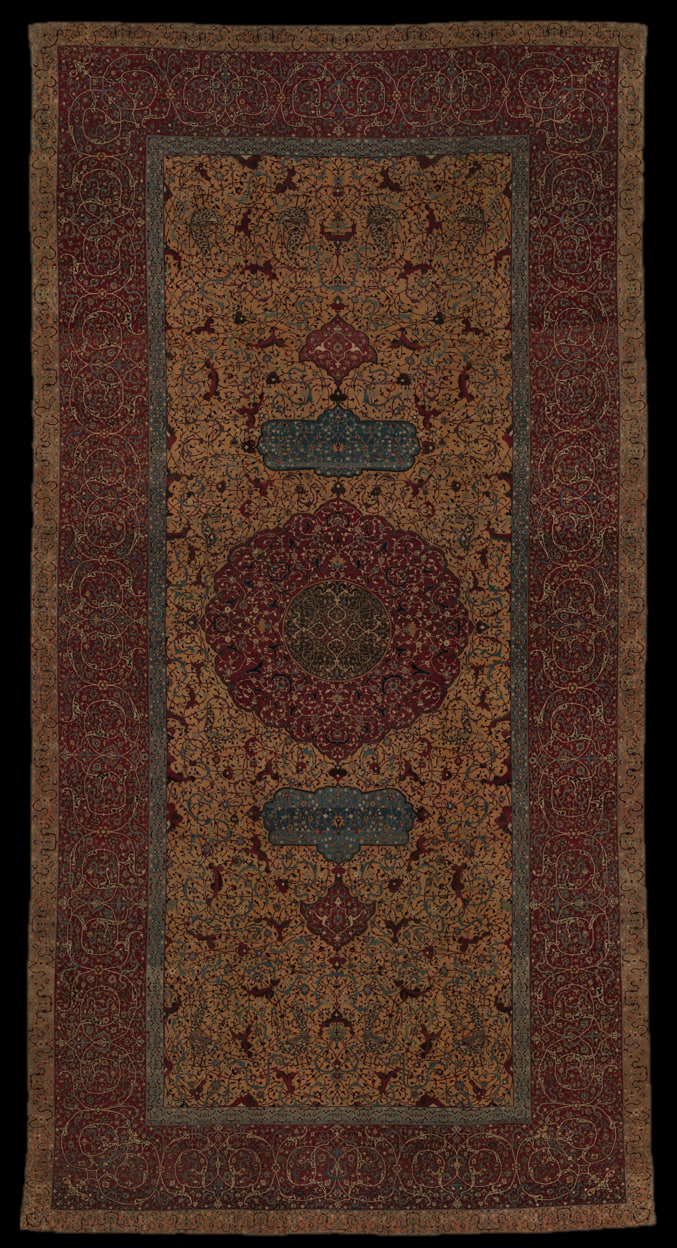

TITLE: The Anhalt Medallion Carpet
ORIGIN: North-west Iran, Tabriz, East Azerbaijan Province
EOCH. PERIOD: Safavid Empire, Iran
DATE: Probably first half 16th century
MATERIAL: Wool, Cotton, Silk
TECHNIQUE: Persian knot, 620,000 knots per sq. m (400 knots per sq.in)
DIMENSIONS : 802 x 412 cm (316 x 162 in.)
- Warp of cotton
- Weft of silk
- Wool Pile
LOCATION: Collection of the Metropolitan Museum of Art, New York, United States
NOTE:
In terms of color, this carpet stands out as a unique example compared to other Safavid period carpets in Iran. It features a classic design with a distinctive yellow background, considered an unusual choice. The central design showcases a “Toranj” pattern surrounded by scrolls of vines and peacocks. This central “Toranj” resembles the covers of contemporary books from the Safavid period, while the arrangement of vines and peacocks in a garden evokes Arabic designs, commonly known as arabesque.
Adjacent to the central “Toranj,” there is a framed section where the leaves culminate. The overall background is intricately adorned with foliage, large lily-shaped red flowers, and thicker branches resembling cloud bands, referred to as “tchi,” prominently encircle it. The woven peacocks exhibit masterful attention to detail and color. The overall design of the carpet exudes a special vitality, attributed to the distinctive colors and intricate details. The border of the carpet comprises three sections. The wider portion features delicate branches whose twists and turns echo the general design of the carpet; the only difference lies in their color.
 Ghalin History
Leave a comment