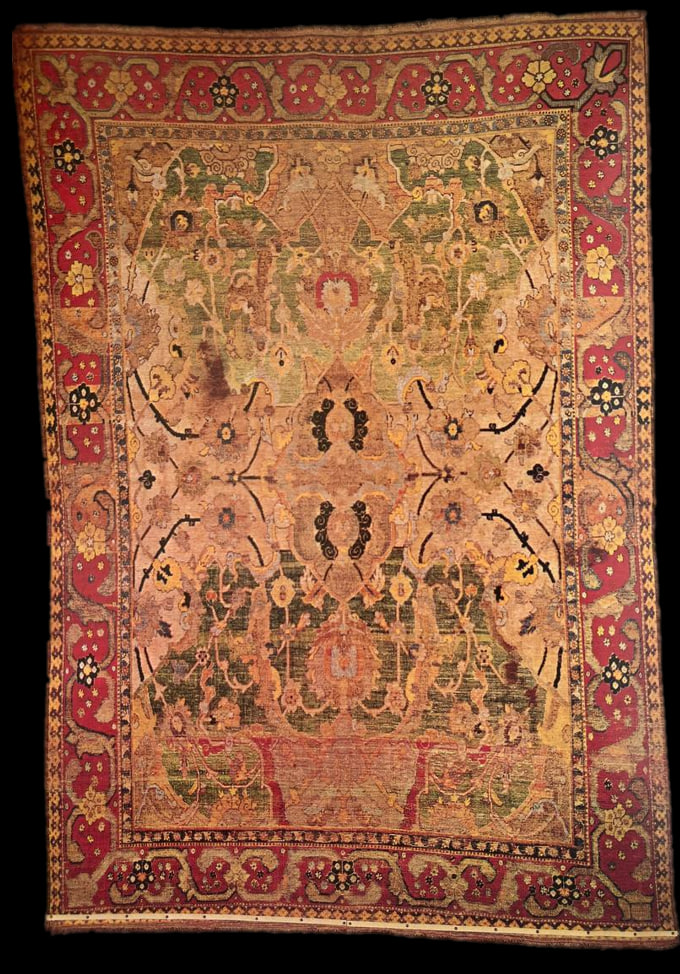
TITLE: Silk Floral Carpet
ORIGIN: Center of Iran, probably Isfahan, Kashan, or Jowshaqan-e Qali
EOCH. PERIOD: Safavid Empire, Iran
DATE: Second half of the 16th century
MATERIAL: Cotton, Silk
TECHNIQUE: Persian knot, 266,800 knots per sq. m (172 knots per sq.in)
- 58 knots per 10 cm. across
- 46 knots per 10 cm. lengthwise
DIMENSIONS : 200 x 135 cm (79 x 53 in.)
- Warp of unbleached Cotton
- Weft of light brown and rosy pink Cotton
- Silk Pile, enriched in parts with Silver and Gold thread
LOCATION: Collection of the Österreichisches Museum Für Angewandte Künst, Vienna, Austria
NOTE:
This carpet features a central and elongated “Toranj,” surrounded by distinct geometric motifs and broad palmettes. The symmetrical background pattern is complemented by cloud-bands strips around the central “Toranj,” showcasing the influence of Chinese art on Persian carpet art during the Safavid era. The carpet’s background is adorned with small flowers, pomegranate patterns, and palm leaves.
In the border of this carpet, red takes on a dominant role. The border design consists of wide, curved strips filled with both small and large flowers. This carpet was historically misidentified as “Polonaise” in 17th-century Europe. This misnomer can be traced back to Iran’s extensive trade relations with Europe during the Safavid era and the royal gifts bestowed by the Safavid court to European governments. However, the actual weaving location of this carpet was in the center of Iran, likely in one of the royal carpet weaving workshops in Isfahan, Kashan, or Jowshaqan-e Qali.
 Ghalin History
Leave a comment