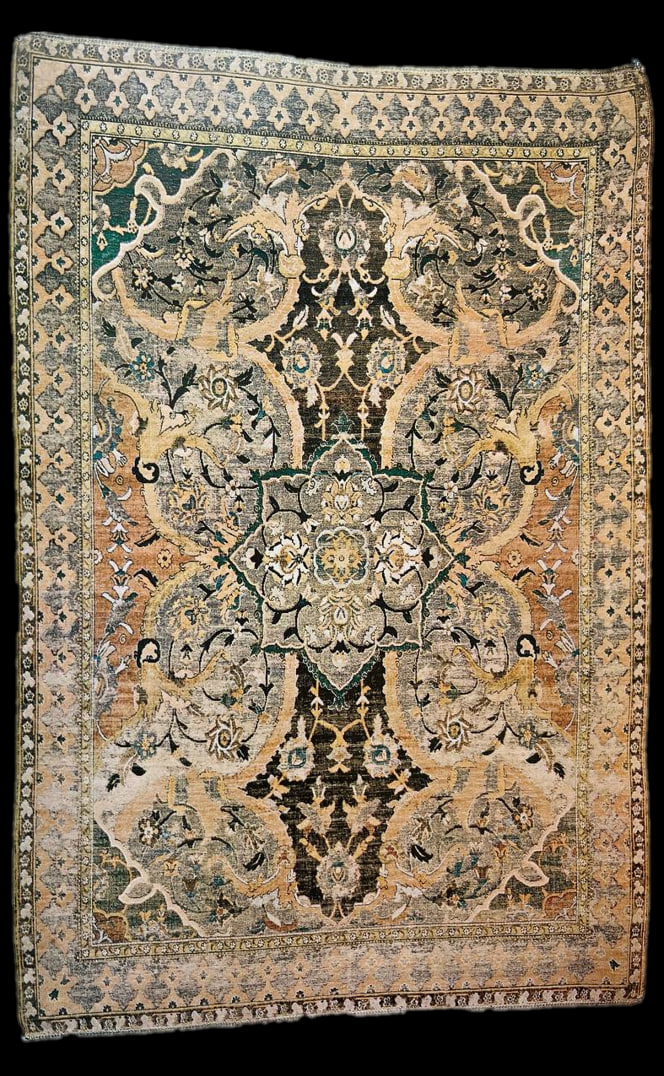
TITLE: Silk Carpet with Arabesques
ORIGIN: Center of Iran, probably Kashan, or Isfahan
EOCH. PERIOD: Safavid Empire, Iran
DATE: End of the 16th Century
MATERIAL: Silk
TECHNIQUE: Persian knot, 740, 000 knots per sq. m (477 knots per sq.in)
DIMENSIONS : 210 x 143 cm (83 x 56 in.)
- Warp of Silk
- Weft of Silk
- Silk Pile, enriched with Silver and Silver-Gilt thread
LOCATION: Collection of the Staatliche Museen, Preussischer Kulturbesitz, Berlin, Germany
NOTE:
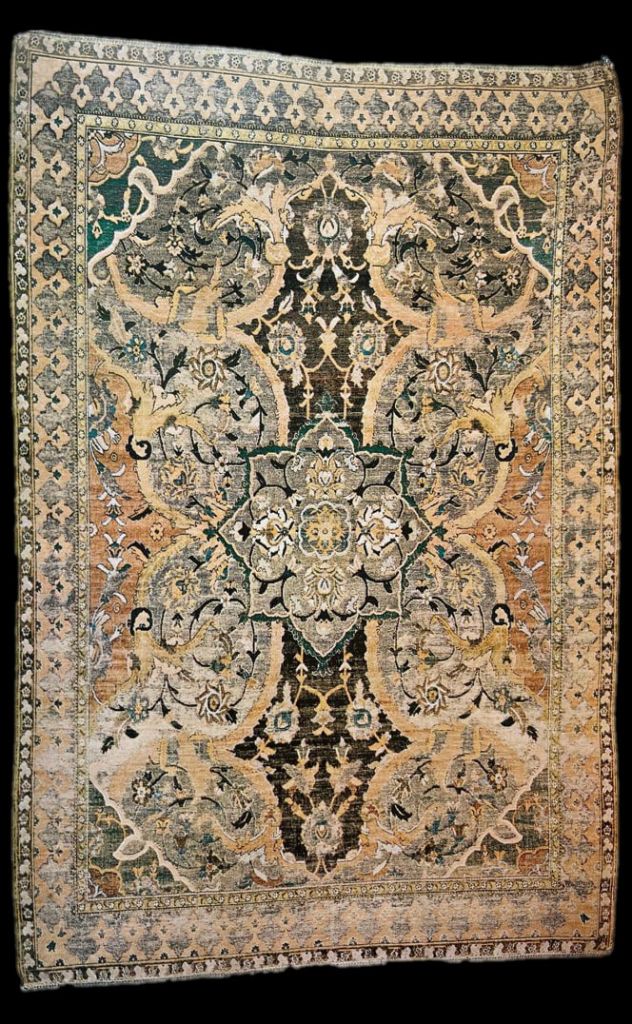
This carpet stands out among Persian carpets for the exceptional quality of materials employed in its creation. Remarkably, gold and silver threads are woven into its fabric, rendering it an exceptionally rare specimen in terms of color richness. The symmetrical pattern, mirrored in both the upper and lower halves, adds to its visual appeal. At the heart of the carpet places a “Toranj,” encircled by a beautifully woven strip in a vibrant green hue, enhancing its overall aesthetic. The green color is also incorporated into the corner motifs of the background.
Woven during the era of Shah Abbās the Great, this carpet is believed to have originated from one of the royal carpet weaving workshops in Kashan or Isfahan during the Safavid period. Although erroneously associated with the name “Polonaise,” this carpet belongs to a collection that garnered this misnomer, possibly due to Safavid court transactions and royal gifts to Europe. Another identical carpet from this collection is held in private collection.
 Ghalin History
Leave a comment