TITLE: Silk Animal Carpet
ORIGIN: Kashan, Isfahan Province, Iran
EOCH. PERIOD: Safavid Empire, Iran
DATE: Second half of the 16th century
MATERIAL: Silk
TECHNIQUE: Persian knot, 921,600 knots per sq. m (595 knots per sq.in)
- 96 knots per 10 cm. across
- 96 knots per 10 cm. lengthwise
DIMENSIONS : 258 x 179 cm (102 x 70 in.)
- Warp of light brown silk
- Double weft of light brown silk
- Silk Pile
LOCATION: Collection of the Metropolitan Museum of Art, New York, United States
NOTE:
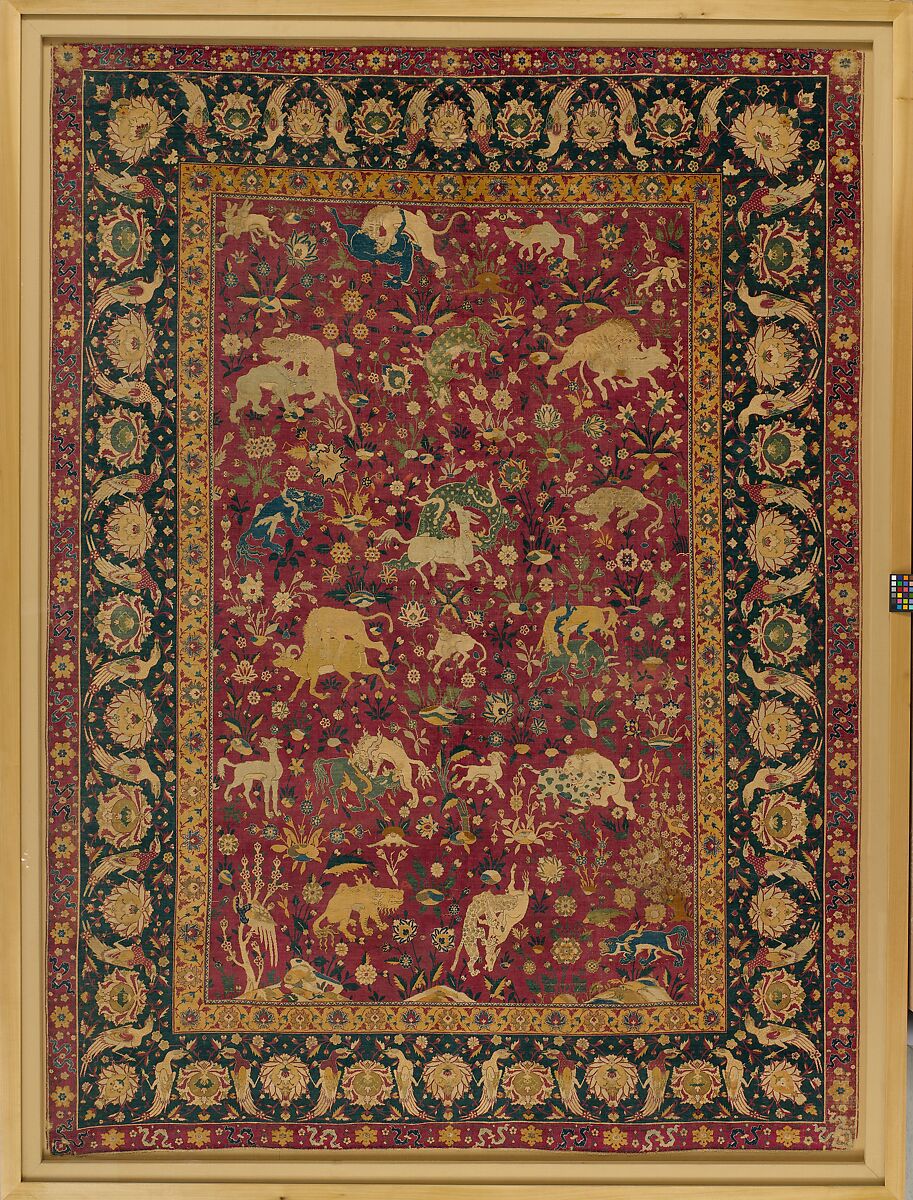
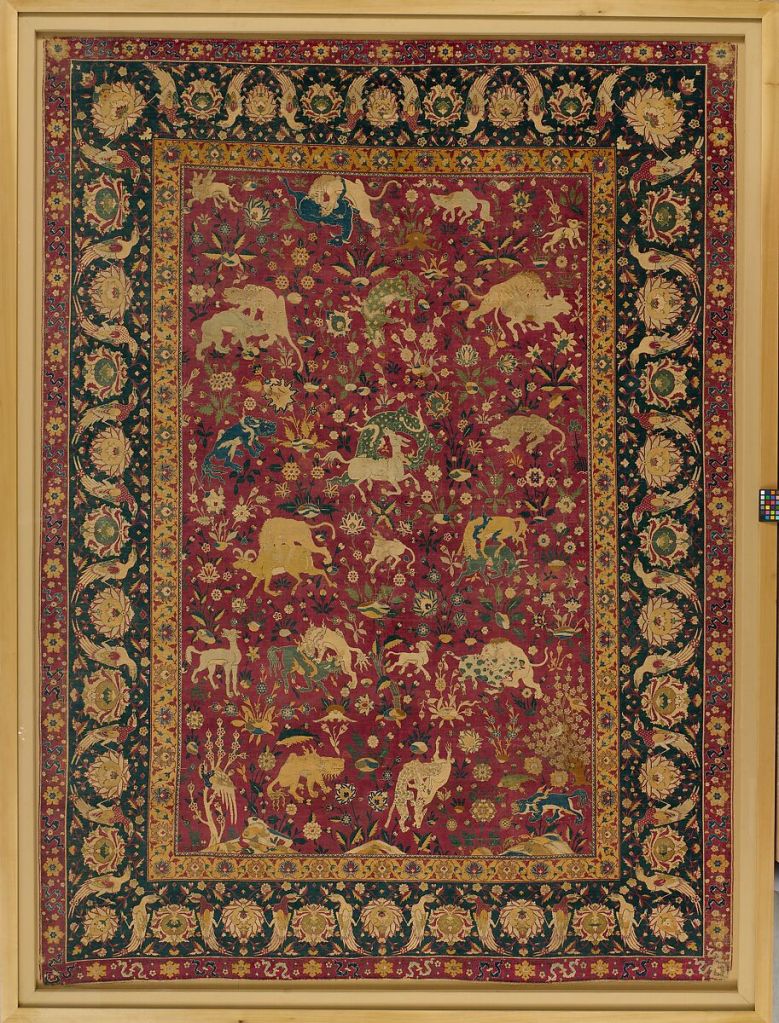
This silk carpet, formerly part of the “Benjamin Altman” collections, belongs to the carpet group featuring animal scenes adorned with intricate floral and leaf patterns. The woven animals include lions, tigers, rams, and fantastical creatures like spotted dragons and horned animals resembling deer, suggesting the evident influence of Chinese art on Iranian art during this period.
The design of this carpet is strikingly reminiscent of a painting rather than a traditional carpet, showcasing a meticulous precision in pattern, texture, and flower design that sets it apart. Notably, it boasts an exceptionally high knot density per square inch, attesting to the pinnacle of carpet quality achieved in 16th-century Iran.
The field’s perimeter comprises three distinct parts. The central and widest section features a palm leaf pattern surrounded by bird motifs, resembling pheasants. The outer border is crafted with cloud-band strips, while the innermost part, the narrowest of all, is adorned with an array of diverse flowers. This combination of elements contributes to the unique and exquisite character of this carpet.
 Ghalin History
Leave a comment