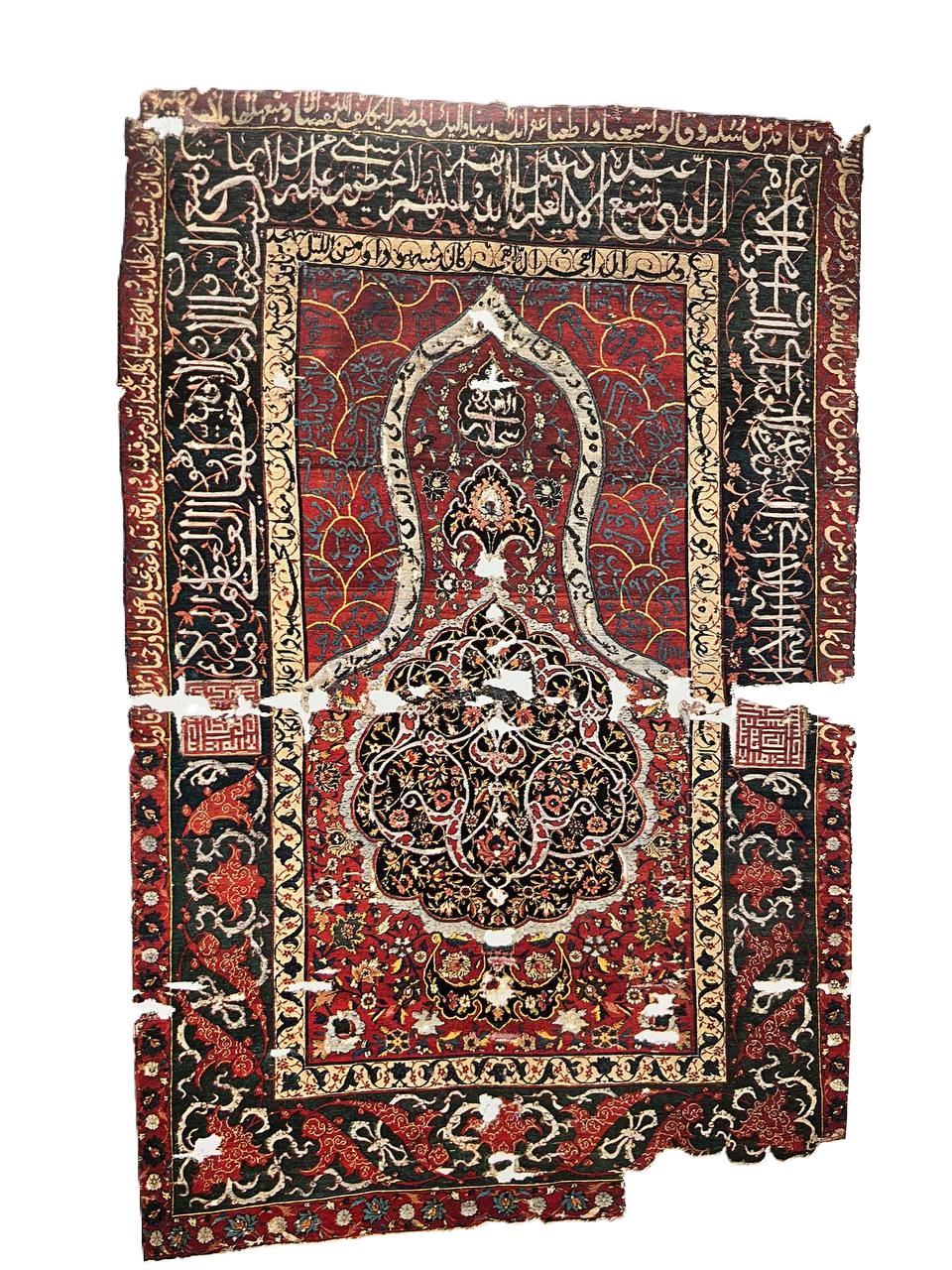
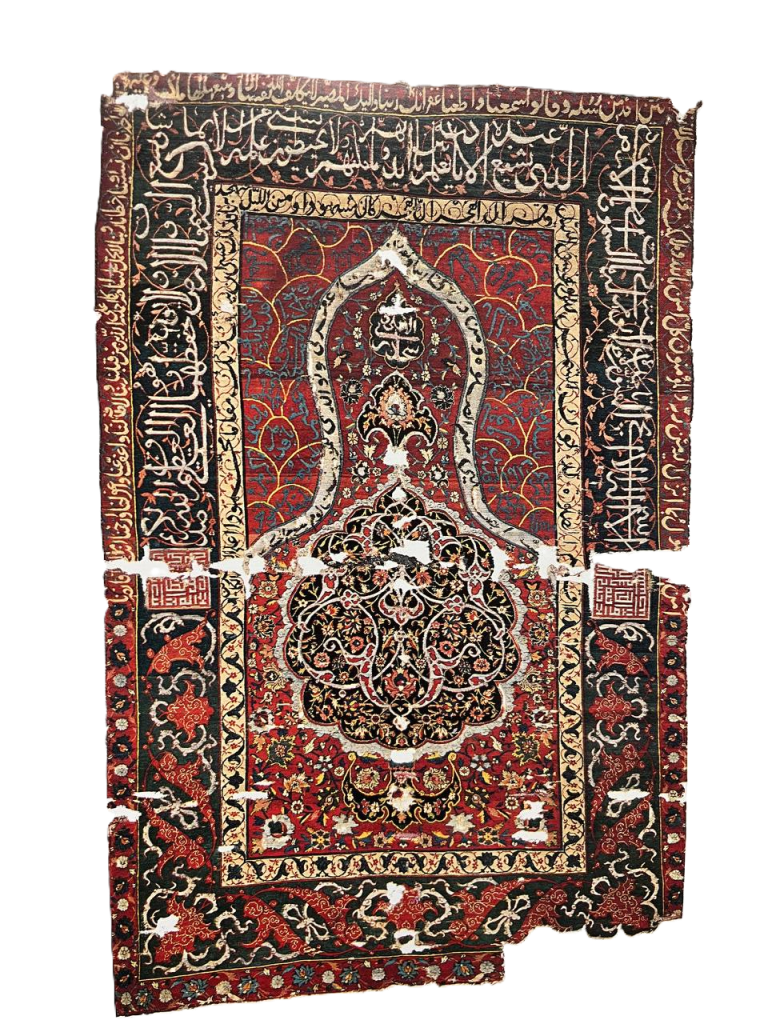
TITLE: Prayer Rug
ORIGIN: North-west Iran, Tabriz, East Azerbaijan Province, or Center of Iran, Isfahan or Kashan, Isfahan Province
EOCH. PERIOD: Safavid Empire, Iran
DATE: End of the 16th century
MATERIAL: Wool, Silk
TECHNIQUE: Persian knot, 675,000 knots per sq. m (436 knots per sq.in)
- 75 knots per 10 cm. across
- 90 knots per 10 cm. lengthwise
DIMENSIONS : 161 x 105 cm (63 x 41 in.)
- Warp of silk
- Weft of silk
- Wool Pile, brocaded with silver thread
LOCATION: Collection of the Museum of Ancient Iran, Tehran, Iran
NOTE:
In the Safavid era in Iran, what we now recognize as “Sajjadeh carpets” were referred to as “Janmazi” and “Mihrabi.” During that period, Janmazi or Mehrabi carpets were the terms used. The mihrab, a recess in the middle of the mosque wall in Islamic architecture, indicates the Qibla’s direction and is typically situated on the south side of the mosque wall in Iran. Essentially, the mihrab functions as the heart of the mosque, showcasing elaborate Iranian and Islamic arts such as Moqarnas and calligraphy. Despite some damage, this small carpet remains beautiful. Museum records and Arthur Upham Pope’s book, “A Survey of Persian Art,” trace the origin of this carpet to Tabriz in northwest Iran. Nevertheless, the presence of the Persian knot suggests the possibility that this “sajjadeh” was woven in central Iran, perhaps Kashan or Isfahan. Carpets and rugs have been produced in Kashan since before the Safavid era, but the mass production of finely woven, expensive, high-quality silk carpets began during the Safavid period. This era witnessed a particular emphasis on art, with Kashan recognized for its cultural and religious significance. Among the initial designs predating Islam were Islamic and Mihrabi patterns. Over time, these designs not only found their way into rugs and carpets but also significantly influenced book design and tile making. This sajjadah, employed for Islamic worship, is adorned with Sermeh silver thread, while Arabic surahs from the Quran adorn its edges.
 Ghalin History
Leave a comment