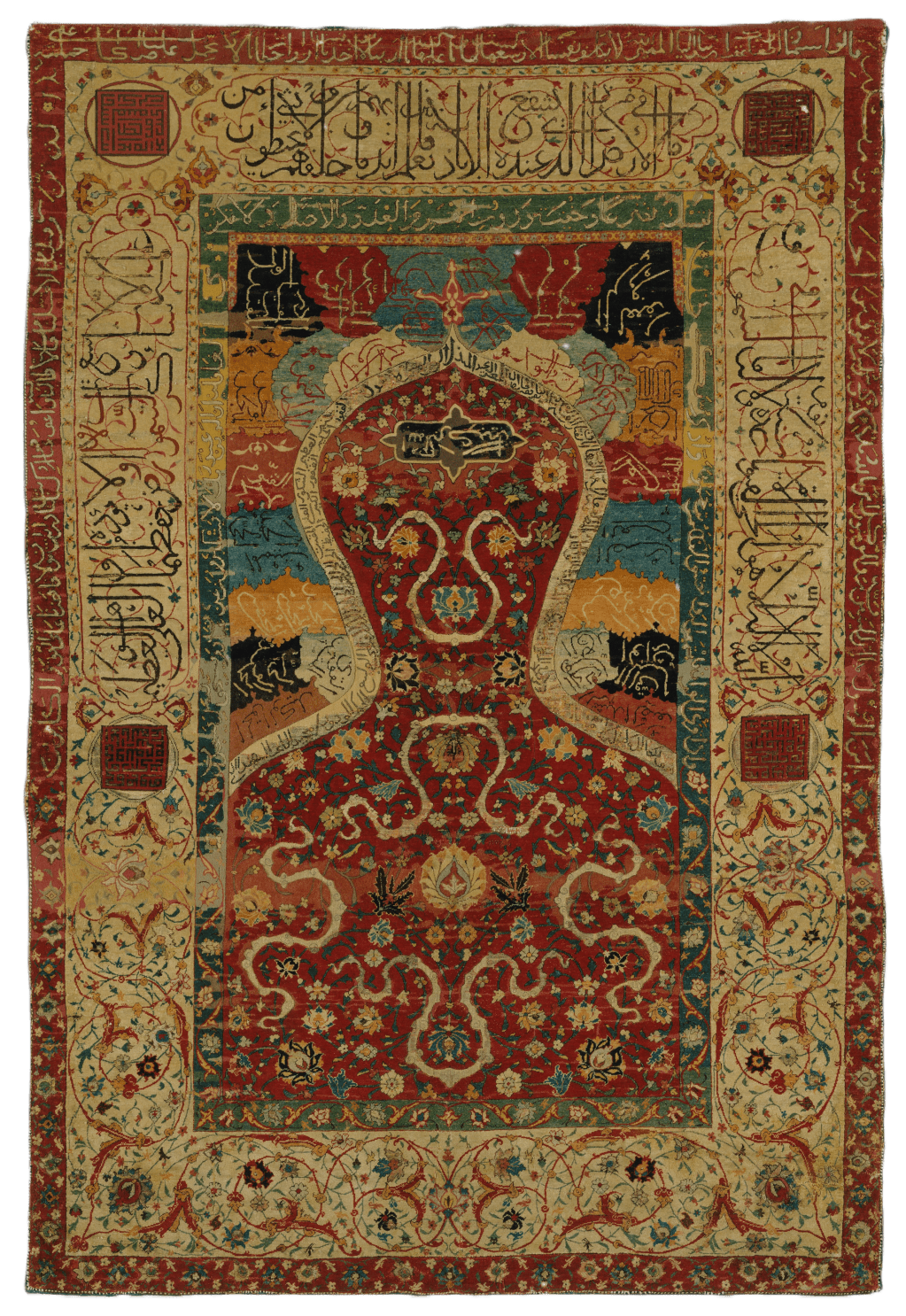

TITLE: Prayer Rug
ORIGIN: North-west Iran, Tabriz, East Azerbaijan Province
EOCH. PERIOD: Safavid Empire, Iran
DATE: Middle of the 16th century
MATERIAL: Wool, Cotton, Silk
TECHNIQUE: Persian knot, 1,000,000 knots per sq. m (645 knots per sq.in)
- 100 knots per 10 cm. across
- 100 knots per 10 cm. lengthwise
DIMENSIONS : 161 x 105 cm (63 x 41 in.)
- Warp of light brown cotton
- Double weft of natural brown wool
- Wool Pile, enriched in parts with silver thread around a silk core
LOCATION: Collection of the Metropolitan Museum of Art, New York, USA
NOTE:
It is a scatter rug, also known as a “Sajjadah,” specifically crafted for worship in Islam. The design of the Sajjadah is inspired by a “Mihrab” (altar) motif, evident in the dome. Within the Mihrab, a pattern unfolds featuring wide claw-shaped leaves, flowers, cloud-band strips, and petite leaves. Quranic inscriptions and the names of God are intricately written in Arabic using the “Naskh” script along the margins of the Sajjadah. The upper part displays the phrase “الله اكبر كبيرا.” Along the border of the central Mihrab, sentences praising God are inscribed.
The line that delineates the Mihrab showcases cloud-like bands of broad leaves, intricately Sermeh embroidered with silver thread. The Sajjadah’s wraps incorporate threads in two colors—one of undyed natural fibers and the other an intense red, a rarity in its kind. The arrangement of these threads is irregular. Some believe this carpet to be a diplomatic gift from Shah Abbas I Safavid to the Ottoman court of Sultan Murad III, based on the promotion of certain shia viewpoints in specific verses. Due to certain verses promoting a Shia perspective by referencing the intercession of Shia imams with God, it appears that the Sunni Ottomans refrained from using this particular Sajjadah. Microscopic examinations reveal remnants of the original edge or border, corresponding to the masterpieces of Safavid-period carpets.
 Ghalin History
Leave a comment