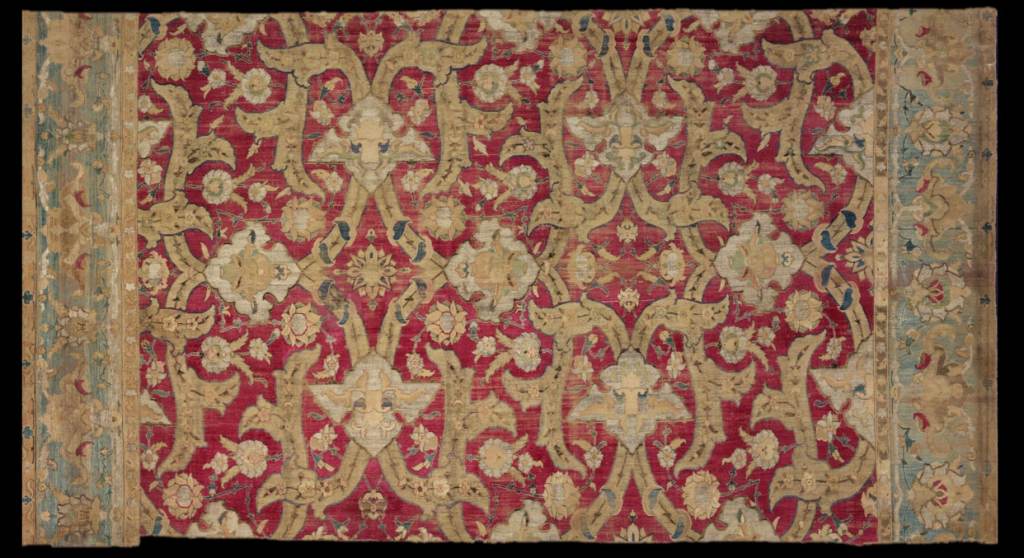
TITLE: Polonaise Carpet
ORIGIN: Center of Iran, probably Kashan, Isfahan or Joshghan-e Qali
EOCH. PERIOD: Safavid Empire, Iran
DATE: Beginning of the 17th Century
MATERIAL: Silk, Gold and Silver Thread
TECHNIQUE: Persian knot, 400,000 knots per sq. m (258 knots per sq.in)
DIMENSIONS : 259 x 145 cm (102 x 57 in.)
- Warp Silk
- Weft of Silk
- Silk Pile, partly enriched with gold and silver thread
LOCATION: Victoria and Albert Museum (V&A), London, United Kingdom
NOTE:
This Iranian carpet has been inaccurately dubbed the “Polonaise.” This carpet is recognized as a Persian piece with a design resembling the carpet donated by Shah ʿAbbās the Great to the shrine in Najaf, Iraq. The misidentification gained traction in the 17th century when a significant number of these carpets were showcased in an exhibition of Prince Czartoryski’s possessions. Mistakenly, it was believed that the origin of these carpets was in Poland. Although this misconception was partially rectified through a 19th-century exhibition of Iranian carpets in Europe, the name “Polonaise” endured.
The inclination towards Persian carpets in Poland during the 17th century is likely attributed to trade relations and royal gifts from the Safavid court to European governments. The carpet’s weaving origin remains a subject of debate, with attributions to Isfahan, Joshghan-e Qali, and Kashan. The design of these fragments, part of a larger carpet, features a combination of flowers, leaves, and strips, creating an aesthetically pleasing composition. The notable harmony of red and gold colors further enhances the overall appeal of this carpet.
 Ghalin History
Leave a comment