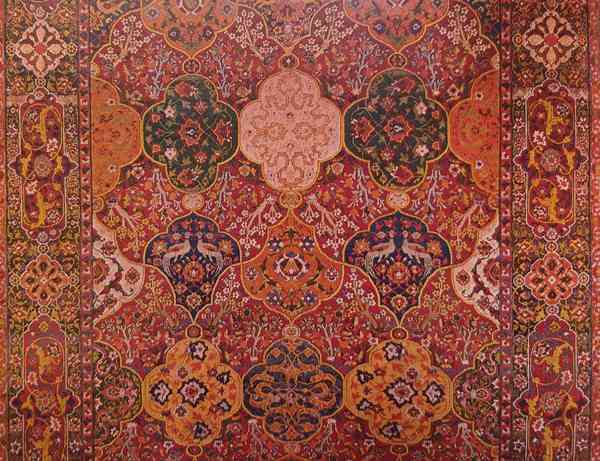
TITLE: Multiple Medallion Carpet
ORIGIN: North-west Iran, Tabriz, East Azerbaijan Province
EOCH. PERIOD: Safavid Empire, Iran
DATE: First half of 16th
MATERIAL: Wool, Cotton
TECHNIQUE: Persian knot, 280, 000 knots per sq. m (181 knots per sq.in)
- 50 knots per 10 cm. across
- 56 knots per 10 cm. lengthwise
DIMENSIONS : 540 x 270 cm (213 x 106 in.)
- Warp of unbleached cotton
- weft of unbleached, yellow and brown cotton
- Wool Pile
LOCATION: Museum of Applied Arts (MAK), Vienna, Austria
NOTE:
The carpet’s design is truly unique, featuring a composition of several “Toranj.” Each individual “Toranj” showcases intricate designs of flowering trees, each characterized by its distinct color and shape. The backdrop of the “Laaki” color (a natural reddish hue) is adorned with lush trees and ripe pomegranates, cracked to an extent that adds an elegant touch to the carpet. The diversity of motifs is apparent even in the branches and leaves constituting the “Toranj.” Cloud-band strips are strategically incorporated in some sections of the design, contributing to the overall background technique.
Within the blue “Toranj,” one can observe “Slimi motifs”, particularly snake-like arabesques, as well as “Khatai motifs” – motifs inspired by flowers and basil, featuring elements such as flowers, leaves, and plant stems. These motifs are skillfully carved alongside depictions of birds, including peacocks, pheasants, and ducks.
The carpet’s edge comprises three distinct parts, with the main section showcasing frames adorned with “Bazoobandi” designs, predominantly geometric shapes and rectangles. These designs incorporate exquisite “Slimi motifs” and are accompanied by “Khatai motifs,” each distinguished by decorative flowers, such as roses. The narrow outer border showcases a rotation of arabesques, while the narrow inner border features a repeated pattern of butterfly flowers, enhancing the beauty of the wide border.
In the classification of Iranian carpet patterns, this carpet falls under the category of “Band-i Ghaabi,” characterized by the placement of various patterns within its numerous frames, some of which are reiterated in other sections.
 Ghalin History
Leave a comment