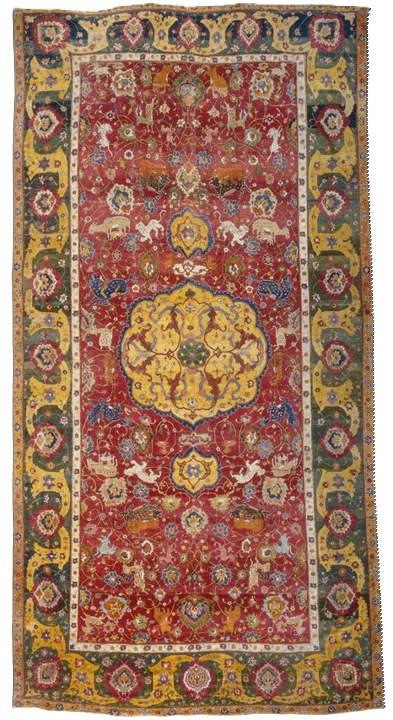
TITLE: Medallion and Animal Carpet
ORIGIN: North-west Iran, Tabriz, East Azerbaijan Province
EOCH. PERIOD: Safavid Empire, Iran
DATE: First half of the 16th century
MATERIAL: Wool, Cotton, Silk
TECHNIQUE: Asymmetric Persian knot, 300, 000 knots per sq. m (194 knots per sq.in)
DIMENSIONS : 427 x 229 cm (168 x 90 in.)
- Warp of wool
- Weft of cotton
- Wool Pile
LOCATION: Collection of the National Gallery of Art, Washington D.C, USA
NOTE:
This carpet, featuring a symmetrical blend and a golden central “Toranj” with accompanying pendants, serves as a testament to its weaving period, specifically the Safavid era. While some attribute its origin to the 17th century, the consensus among experts places it firmly in the first half of the 16th century. A distinctive characteristic of this carpet lies in the integration of imaginary animals alongside real ones. Notably, an animal is portrayed, with one half resembling a deer and the other a dragon, engaged in a hunting scene. Throughout the entire carpet field, expertly woven flowers and foliage complement the overarching pattern. The central “Toranj” is intricately carved with cloud-band strips.
The wide border of the carpet showcases a unique combination of relatively broad floral “Islimi” strips and cartouches featuring “Shah Abbasi” patterns. While it may seem that the wide border doesn’t seamlessly match its background, the overall aesthetic of the carpet is undeniably attractive and distinctive. The overall design bears resemblance to an animal-view carpet housed in the Milan Museum.
 Ghalin History
Leave a comment