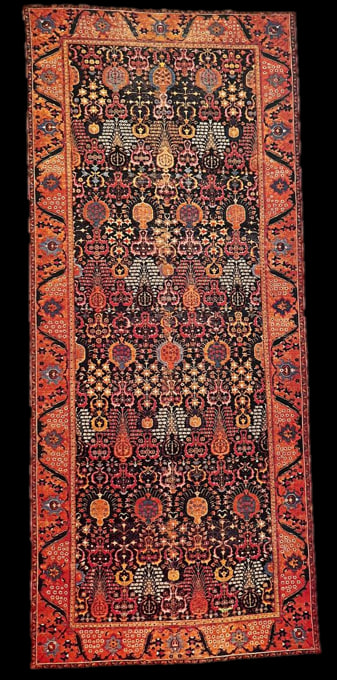
TITLE: VASE Carpet
ORIGIN: Kerman, Souths-East of Iran
EOCH. PERIOD: Safavid Empire, Iran
DATE: Beginning of the 17th century
MATERIAL: Cotton, Wool
TECHNIQUE: Persian knot, 189,200 knots per sq. m (122 knots per sq.in)
- 44 knots per 10 cm. across
- 43 knots per 10 cm. lengthwise
DIMENSIONS : 610 x 255 cm (240 x 100 in.)
- Warp of unbleached Cotton
- Weft of light brown Cotton
- Wool Pile
LOCATION: Collection of the Österreichisches Museum Für Angewandte Künst, Vienna, Austria
NOTE:
The distinct design of this carpet is what attributes it to the city of Kerman in the southeast of Iran. During the Safavid period, the “Goldan” or vase design gained prominence in Kerman. Notably, this carpet’s design deviates from symmetry, leaning towards one side and executed in eight rows. Initially, the repeated pattern in the rows might not be readily apparent, yet upon closer inspection, it becomes discernible within the background. Golden vases woven into the carpet serve as the focal point, from which clusters of flowers, branches, and leaves emerge, surrounded by smaller floral motifs. Overall, this carpet stands out as a particularly exquisite example within the vase category. The border design of the carpet mirrors the main motif, featuring large flowers, branches, and leaves. Despite not being woven from silk, the coloring of this carpet is strikingly beautiful. Subtle shades of green in the background, though less conspicuous to the untrained eye, add depth and richness to the composition. Kerman remains a prominent hub for carpet weaving in Iran.
 Ghalin History
Leave a comment