TITLE: Hunting Carpet
ORIGIN: North-west Iran
EOCH. PERIOD: Safavid Empire, Iran
DATE: First half of the 16th Century
MATERIAL: Wool, Cotton, Silk
TECHNIQUE: Persian knot, 409,200 knots per sq. m (264 knots per sq.in)
- 62knots per 10 cm. across
- 66 knots per 10 cm. lengthwise
DIMENSIONS : 570 x 365 cm (224 x 123 in.)
- Warp of yellow silk
- Wrap of brown cotton
- Wool Pile: The white parts of cotton
LOCATION: Museo Poldi Pezzoli, Milan, Italy
NOTE:
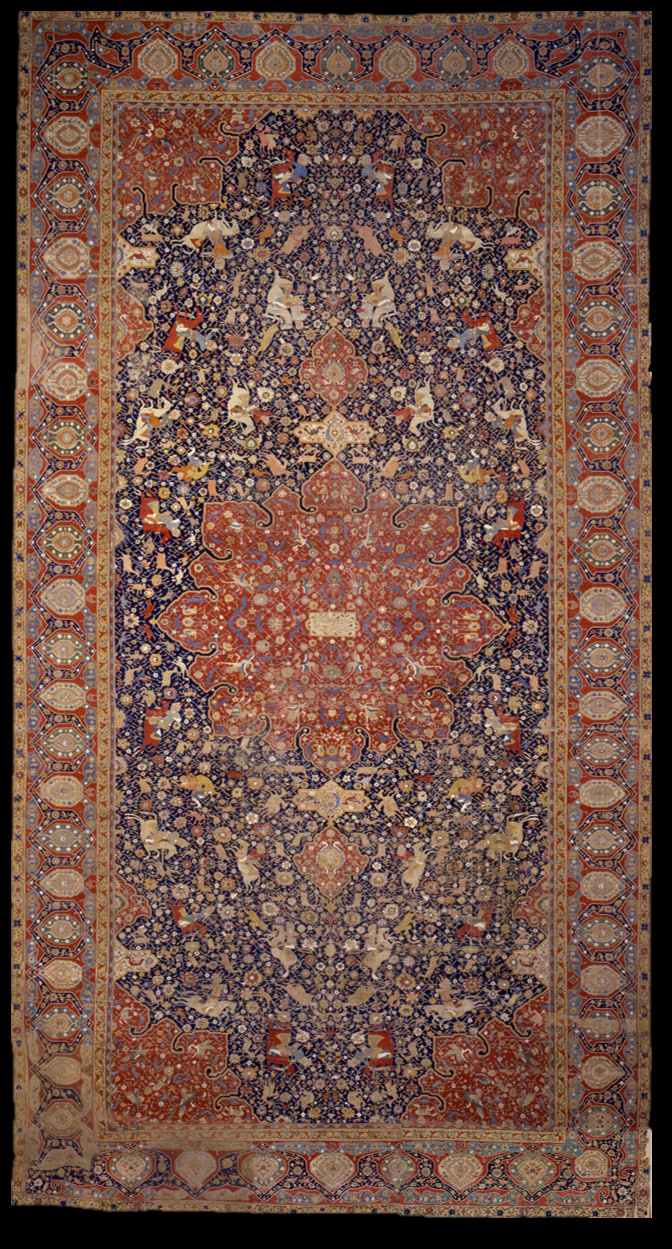
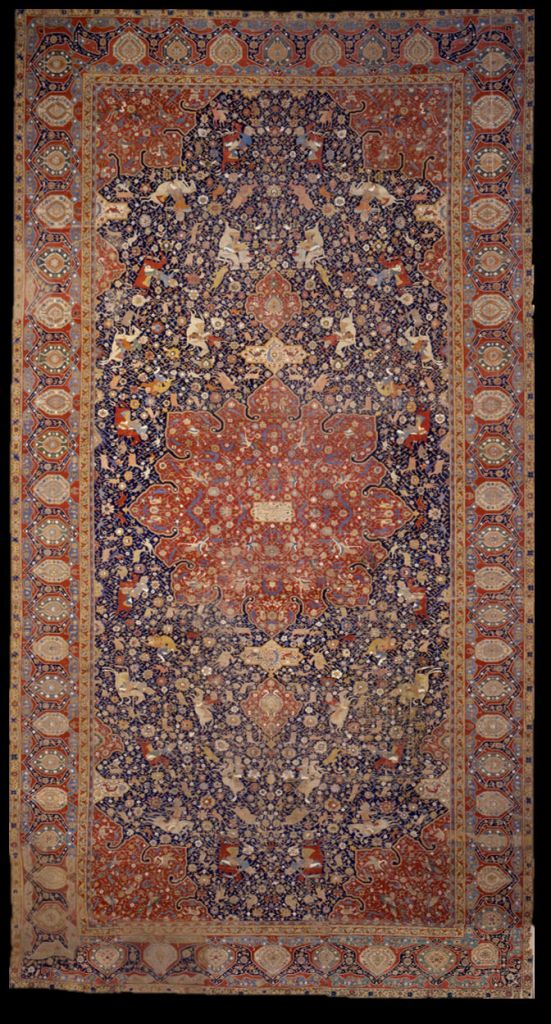
In terms of beauty and the delicate texture, the hunting scene carpet stands as an unequivocal masterpiece in the realm of carpet weaving art worldwide. A notable feature of this carpet lies in its color balance. Each corner of the carpet showcases a quarter of a large sixteen-pointed “Toranj” pattern. At the carpet’s center, an octagonal “Toranj” contributes to the overall color harmony. Within this central “Toranj,” a frame bears the name of the weaver, Ghiyathuddin-i-Janni, and the weaving date is inscribed as 1543 (949 in the Persian Hijri Calendar).
Upon closer inspection of the carpet’s pattern, one can discern four perfectly symmetrical sections depicting a hunting scene. In this hunting ground, seven horseback riders and one pedestrian hunter seek various animals, including lions, antelopes, bears, lynxes, cheetahs, and boars. A keen eye will reveal additional details such as deer and falcons lurking near hares.
The carpet’s border features several “Toranj” motifs adorned with foliage, along with meandering bands embellished with flowers and birds. Originally part of the Italian royal family’s possessions, the carpet underwent division into multiple pieces during that period, subsequently reassembled.
 Ghalin History
Leave a comment