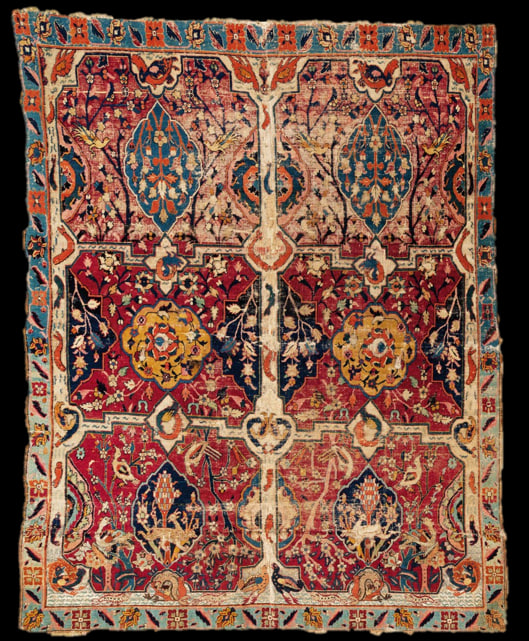
TITLE: Garden Carpet
ORIGIN: North-west Iran, Heris County, East Azerbaijan province
EOCH. PERIOD: Safavid Empire, Iran
DATE: Beginning of the 16th Century
MATERIAL: Wool, Cotton, Silk
TECHNIQUE: Persian knot, 307,200 knots per sq. m (198 knots per sq.in)
- 64 knots per 10 cm. across
- 48 knots per 10 cm. lengthwise
DIMENSIONS : 187×151 cm (74 x59 in.)
- Warp of unbleached cotton
- Weft of unbleached, red, and yellow cotton, one strand of yellow silk
- Wool Pile: Brocading of silver and gold on silk thread
LOCATION: Museum of Applied Arts Vienna, Austria
NOTE:
You are observing the oldest known carpet featuring a garden motif, named “Naqsh Bagh” in Iran, also referred to as “Naqsh Qabi,” indicating its provincial origin. The garden design of carpets is typically shaped by the creative spirit of carpet designers, reflecting the manifestations of the nature that surrounds them. The design of this hand-woven carpet aligns closely with this ethos, abstractly bringing the essence of a garden into the space.
The main field is divided into six sections, bordered by water canals containing fish. Upon closer inspection, ducks can be seen engaged in the pursuit of fish. At the center of each section lies a “Toranj” or medallion motif adorned with depictions of birds, deer, flowering trees, and quivering leaves. Within each “Toranj”, a motif of the “Shah Abbasi” flower is featured, with branches of various flowers circulating in the fields, inclining towards four feathers and the “Shah Abbasi” flower, all interconnected by double leaves.
In the corners of each section, a “half-Toranj” pattern is present. When considered in the broader context, these “half-Toranj” motifs, when combined with those in the adjacent sections, collectively form complete “Toranj” designs.
 Ghalin History
Leave a comment