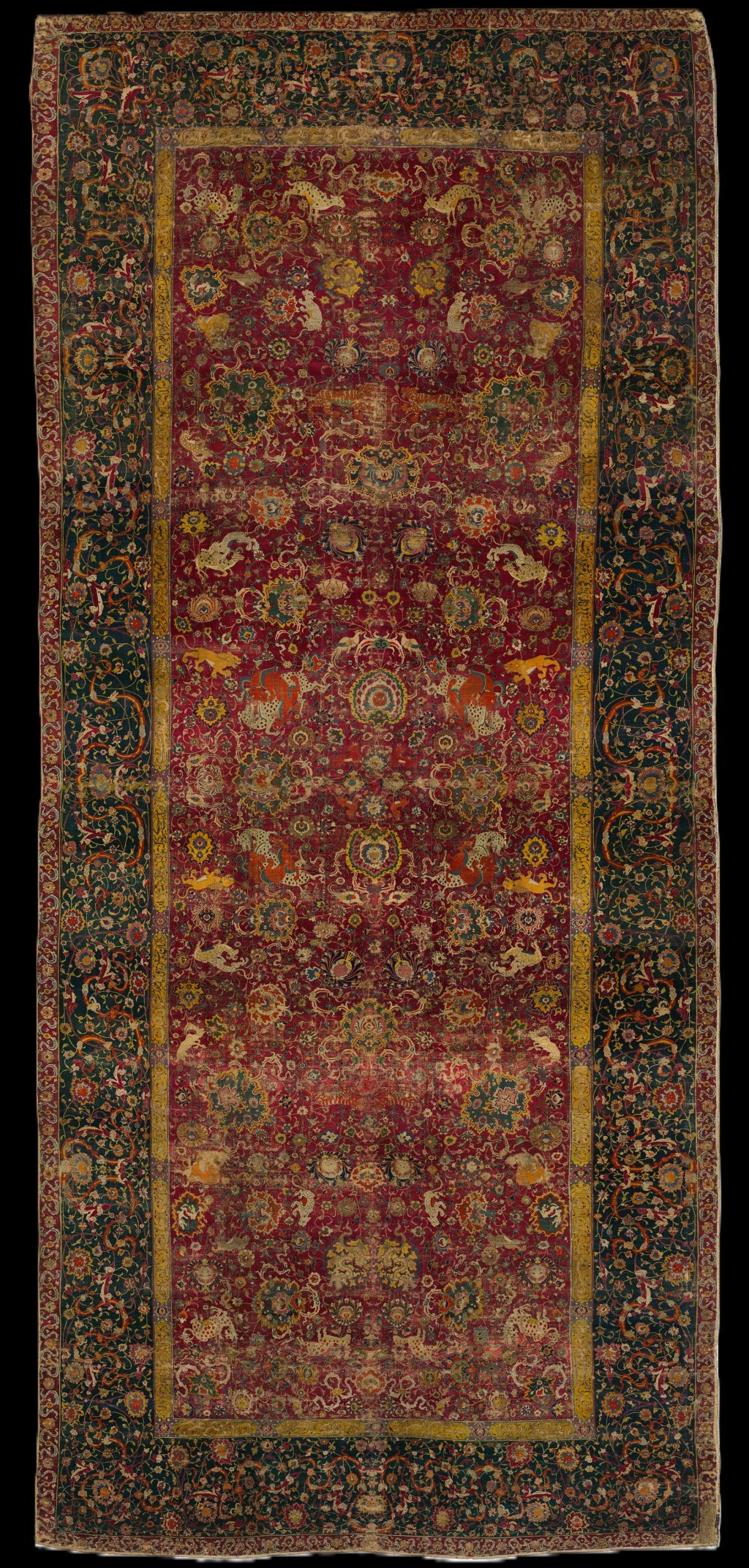
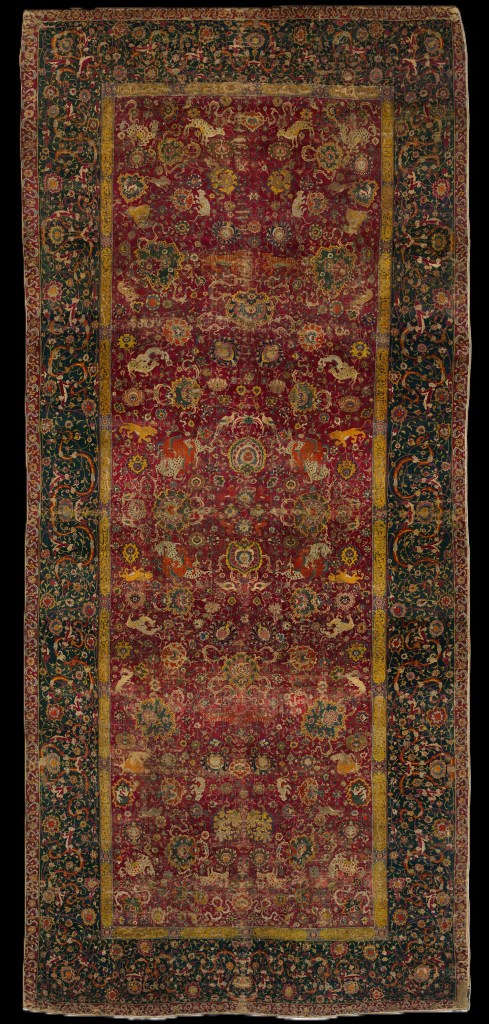
TITLE: Emperor’s Carpet (Allover Animal and Floral Carpet)
ORIGIN: Isfahan, Iran
EOCH. PERIOD: Safavid Empire, Iran
DATE: Middle of the 16th century
MATERIAL: Wool, Silk
TECHNIQUE: Persian knot, 495,000 knots per sq. m (319 knots per sq.in)
- 66 knots per 10 cm. across
- 75 knots per 10 cm. lengthwise
DIMENSIONS : 760 x 325 cm (299 x 128 in.)
- Warp of brownish-yellow silk
- Weft of light brown silk
- Wool Pile
LOCATION: Collection of the Metropolitan Museum of Art, New York, United States
NOTE:
The carpet’s design is symmetrically divided into four equal parts, featuring intricately woven leaves, palm trees, and cloud-like stripes against a floral background. The intricate design also incorporates depictions of battling animals and birds, including pheasants, ducks, lions, tigers, dragon leopards, buffaloes, and antelopes. These creatures are skillfully interwoven among the lush foliage, requiring careful observation to discover them within the carpet’s intricate patterns. Notably, some animals are subtly hidden, revealing only their heads, showcasing innovative texture in the carpet’s design.
This particular carpet once adorned the summer residence of the Habsburg emperors. A verse discovered on the inner protective tape draws a poetic comparison between a garden in spring and the splendor of the Garden of Heaven.
 Ghalin History
Leave a comment